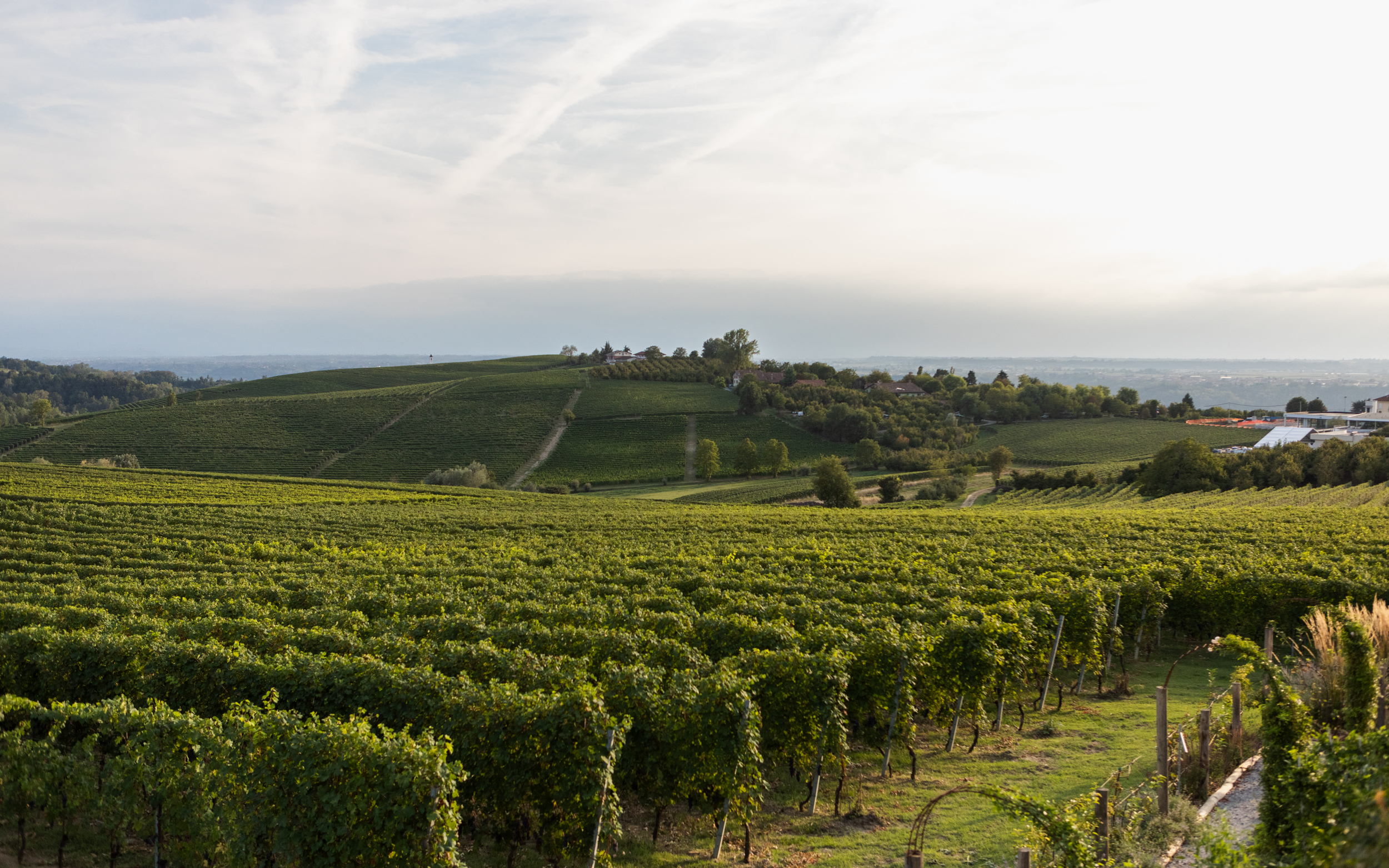
There are places that don’t need grand introductions. You simply arrive, look around, and let yourself be captivated by everything surrounding you.
Bricco delle Viole is one of them.
We are in Barolo, in one of the most recognizable and fascinating areas of the Langhe, where the vine is not just cultivation, but an integral and essential part of how the land tells its story. Here every hill has a name, every slope has its own personality, every row of vines seems to hold a subtle difference capable of changing the character of a wine. We are famous all over the world for exactly this reason.
Bricco delle Viole is not simply a location. It is one of the Additional Geographical Mentions of Barolo DOCG, meaning one of those officially recognized areas that allow for a more precise origin to be indicated on the label within the denomination. A name that, for wine lovers, represents identity, altitude, light, and a particular idea of elegance—a precise direction shaped by conscious and deliberate choices made among the vines and in the cellar.
A hilltop that is high, bright, and distinctive
The first element that makes Bricco delle Viole special is its location.
We are in one of the highest areas in the municipality of Barolo, on a slope that develops roughly between 400 and 480 meters above sea level. Some sources even indicate elevations around 500 meters, confirming a fundamental point: here, the vineyard rises, breathes, and takes in air.
This elevation is not just a technical detail for experts, but something you can perceive even walking through the vineyards. The landscape opens up, the light changes, the horizon stretches toward the Alps. And the vine, under these conditions, grows with a particular balance.
Altitude brings more pronounced temperature variations, bright days, and cooler nights. For Nebbiolo, a demanding and sensitive grape variety, all of this is invaluable: it supports slow, progressive ripening, capable of preserving freshness, aromas, and tension in the wine.
Light: one of the true treasures of Bricco delle Viole
Bricco delle Viole benefits from highly favorable exposures, mainly facing south and southeast. It is an area that receives generous light from morning until the final hours of the day. Not surprisingly, many descriptions of this cru emphasize this very aspect: here, sunlight is not just warmth, but constant energy, presence, and rhythm—reflected in the extraordinary wines produced in this area.
The name itself, Bricco delle Viole, is often linked to the violets that bloom in spring thanks to the hill’s favorable exposure. It’s a poetic detail, certainly, but also a very concrete one: it tells of a microclimate, an early development, a living environment.
In autumn, this area offers one of the most evocative views of the Langhe. The higher vineyards can rise above the fog, as if suspended. Below, a white sea of cold morning mist. Above, the sun illuminating the rows of vines. It’s a scene that explains better than words why wine here is never just an agricultural product.
Nebbiolo and altitude: a delicate relationship
Nebbiolo is a grape variety that leaves little room for error. It needs time, exposure, suitable soils, and skilled hands. It ripens late, demands attention, and changes significantly from one hill to another.
At Bricco delle Viole, it finds particularly interesting conditions: high elevation, excellent exposure, ventilation, clay-limestone soils, and significant brightness. Producers and specialized sources often describe elegant wines, refined, aromatic, with evident freshness and a structure capable of evolving over time.
It is precisely here that the deeper meaning of the word “cru” becomes clear. It does not simply indicate a famous vineyard. It indicates a precise relationship between place, climate, soil, exposure, and human work. In other words: a wine that could not be born the same anywhere else.
Bricco delle Viole is an imprint.
Barolo, history and nobility: a story that begins far away
Modern Barolo is traditionally linked to the figure of Marchesa Giulia Colbert Falletti of Barolo and the work of the French oenologist Louis Oudart. According to the most widespread account, in the 19th century Oudart helped transform the local wine into a dry, structured red suitable for aging, capable of winning over royal courts and the Piedmontese aristocracy.
However, scholars advise caution regarding this story: some interpretations question Oudart’s central role and suggest that Barolo’s origin was likely the result of multiple factors, people, and skills developed over time.
This does not diminish the charm of the story. On the contrary, it makes it even more compelling. Barolo was not born from a magical formula, but from an extraordinary territory that, at a certain point, encountered vision, technique, and ambition.
From noble lands to contemporary quality
For a long time, Barolo was associated with important, noble, almost ceremonial consumption. It was the wine of great occasions, of prestigious tables, of cellars to be patiently preserved.
Today, its prestige has not been lost, but transformed. It is no longer only the “wine of kings,” as the famous definition goes. It is also a wine of territory, of growers, of families, of personal interpretations.
Here, in this cru, this evolution is clearly visible: on one side, there is the grand history of Barolo, with its imagery of castles, marquises, historic cellars, and bottles destined for aging. On the other, there is the daily work in the vineyard: pruning, waiting, harvests, selections, vintages to understand and guide.
The result is a quality that does not happen by chance. It is the outcome of a long cultural selection even before an agricultural one: understanding which places are most suited, respecting them, and interpreting them without distorting their essence.
A place to experience, not just to taste
Those who stay here find themselves immersed in a landscape that is both agricultural and scenic. The vineyards are not just a backdrop: they are the very fabric of the territory. They change color with the seasons, shape the hills, accompany the roads, and tell the story of human work without erasing the power of nature.
In spring come the first greens and blossoms. In summer, the vineyard grows full, orderly, vibrant. In autumn, Nebbiolo reaches maturity and the landscape lights up with deep colors. In winter, everything feels more essential: bare rows, soil, hills, silence.
Each season reveals a different face of the same place. And perhaps this is the true privilege of staying in Barolo, at Bricco delle Viole: not just visiting the Langhe, but inhabiting them for a few days.
The privilege of being in the right place
There are beautiful places. And then there are places that, beyond being beautiful, have something to say.
Bricco delle Viole belongs to the latter. It is beautiful, certainly. But above all, it is a place that explains why wine can become culture, memory, landscape, identity.
Here, Barolo is not an abstract label. It is a natural consequence of the place where it is born: altitude, light, soil, exposure, history. It is the result of a land that has been observed, cultivated, and interpreted for generations.
Staying in this area means being in one of the most fascinating points of the municipality of Barolo, where the territory does not need to be described with special effects. Just look outside, follow the lines of the vineyards, and understand that certain places have become famous for a very simple reason: they are unique.